
Military and aerospace electronics operate where innovation and reliability intersect. Whether supporting communications, electronic warfare, radar, autonomous systems, or space-based platforms, these technologies must deliver increasingly sophisticated functionality while surviving some of the harshest possible operating environments.
With that said, defense and aerospace programs are now facing a new challenge: providing more capability in smaller, lighter, and more power-efficient systems. At the same time, traditional approaches to semiconductor scaling are becoming more complex and expensive, and, in some cases, are insufficient to meet evolving mission requirements. As a result, heterogeneous integration (HI) is gaining momentum as an important design and manufacturing strategy for next-generation military and aerospace systems.
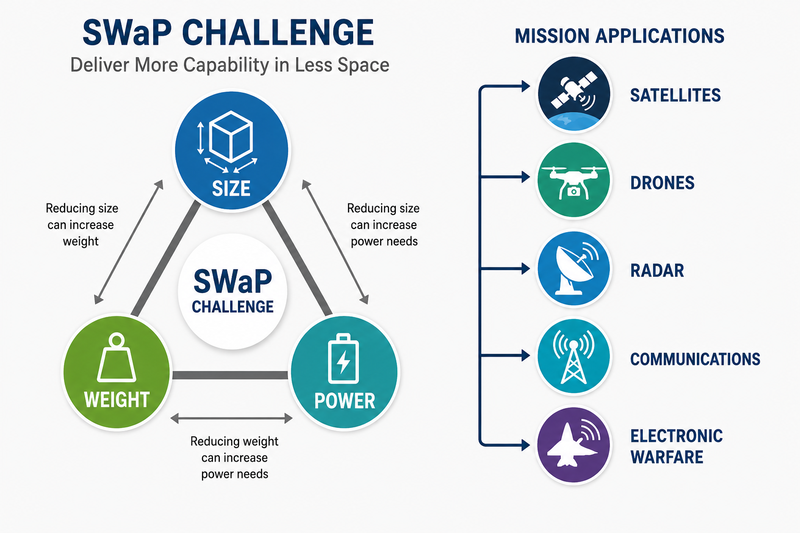
More Capability, Less Space The demand for reduced size, weight, and power (SWaP) has become a defining requirement across much of the defense and aerospace landscape. Whether deployed in satellites, unmanned systems, portable communications equipment, surveillance platforms, or advanced sensors, electronic systems are expected to do more while consuming fewer resources (see Figure 1).
At the same time, these systems increasingly incorporate diverse technologies. High-performance processors, memory, RF components, sensors, MEMS devices, power management circuitry, and other specialized functions often need to operate together within highly constrained spaces.
Historically, many of these functions would have been implemented using separate components mounted across a circuit board. Today, that approach often creates unacceptable penalties in size, weight, power consumption, and performance. The industry’s response has been a growing shift toward HI.
What Is Heterogeneous Integration?
At its simplest, HI refers to the integration of multiple technologies, devices, or functions into a single package, module, or subsystem. Rather than relying on a single semiconductor device to perform every task, HI allows designers to combine the best technologies for each function. Processors can be integrated alongside memory, RF devices, sensors, photonics, MEMS components, and power devices within highly optimized architectures. The result is a system that can deliver greater functionality within a significantly smaller footprint.
For military and aerospace applications, HI offers advantages that extend well beyond miniaturization. It can improve signal integrity, reduce interconnect distances, lower power consumption, enhance system performance, and enable capabilities that may be difficult or impossible to achieve using traditional board-level approaches. As mission requirements continue to evolve, these benefits are becoming increasingly valuable.
Customers often approach Promex with concepts that combine technologies not previously integrated into a single module. We help identify technical risks early, evaluate materials and assembly approaches, and determine the most reliable path to qualification and production. This includes manufacturability, which must be considered alongside device performance—we work with customers early in development to ensure their innovative concepts can also be manufactured and qualified reliably. We ask hard questions regarding the mission profile so that we understand everything from material selection to package architecture and qualification strategy to ensure successful HI implementation.
Reliability Remains Non-Negotiable
While HI opens the door to new levels of performance and functionality, military and aerospace applications raise the reliability stakes. Unlike many commercial electronics products, defense and aerospace systems often operate for extended periods in environments characterized by extreme temperatures, vibration, shock, acceleration, radiation exposure, and long deployment cycles. Some systems may remain dormant for years before being called into service. Others must perform flawlessly through repeated exposure to harsh operational conditions.
Success therefore requires more than simply integrating advanced technologies into a compact package. Every material, assembly process, interconnect structure, and packaging decision must be evaluated through the lens of long-term reliability. This is where many organizations encounter significant challenges.
Integrating multiple device types into a single module creates new interactions between materials, thermal profiles, mechanical stresses, and manufacturing processes. The more advanced the architecture becomes, the greater the need to understand how those interactions will affect performance over the product’s lifetime. Achieving this balance between innovation and reliability requires deep expertise in materials science, assembly processes, mechanical modeling, qualification planning, and mission-profile analysis.
Bridging Innovation and High Reliability
One of the reasons HI is gaining traction within military and aerospace applications is that many of the challenges are analogous to those found in other high-reliability industries. For example, long-term implantable medical devices often face stringent reliability requirements that closely resemble those encountered in defense applications. In both cases, systems must continue operating reliably for extended periods while incorporating increasingly sophisticated functionality within highly constrained form factors.
The lessons Promex has learned from years of developing advanced medical assemblies are proving highly relevant as military and aerospace programs adopt more complex HI strategies. This cross-disciplinary expertise becomes particularly valuable when our customers seek to combine technologies that have not traditionally been integrated together. Sensors may be added to existing devices to provide environmental awareness. MEMS components may be incorporated alongside communications electronics. New combinations of RF, processing, and sensing technologies may be required to support emerging mission requirements.
In many cases, the technical feasibility of the concept is only part of the challenge. Understanding how to manufacture, test, qualify, and sustain these systems over a 10- to 15-year program lifecycle is equally important. This is another benefit of working with an experienced contract manufacturer like Promex. As with medical devices, aerospace and defense applications have lengthy development cycles and lifetimes—making Promex’s expertise and experience in the medical space directly applicable and transferable.
Reducing Risk Through Development
Another factor shaping today’s military and aerospace market is the need to manage development risk. While defense programs continue to pursue ambitious technical goals, funding constraints and development costs require careful investment decisions. Organizations must find ways to validate new technologies without exposing entire programs to unnecessary risk.
A structured, phased development approach can play an important role in addressing this challenge.
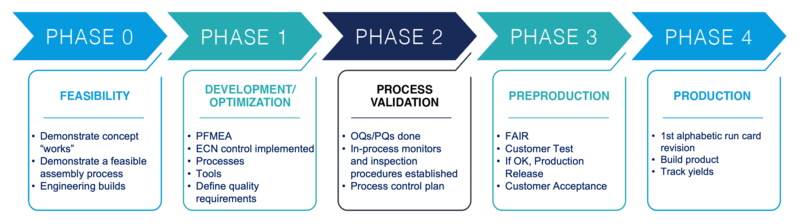
By breaking complex programs into manageable stages, teams can evaluate technical risks, validate critical assumptions, and build confidence before committing to larger investments. Promex’s Phase Gate Process helps customers navigate the transition from concept development and prototyping through qualification and eventual production, as shown in Figure 2.
Equally important, it allows reliability and test considerations to be incorporated early in the design process rather than treated as an afterthought. Promex works with customers to determine what testing is required, when it should occur, key success criteria, and how reliability will be demonstrated over time – decisions that can significantly improve program outcomes.
Preparing for the Next Generation of Defense Electronics
Looking ahead, HI is likely to play an increasingly important role across military and aerospace systems. As platforms continue to demand greater functionality within constrained SWaP budgets, designers will increasingly rely on advanced modules that combine multiple technologies into highly integrated architectures. Power management, sensing, communications, computing, and secure connectivity will all continue to drive innovation.
At the same time, emerging standards and qualification frameworks are helping establish pathways for broader adoption of advanced packaging and integration technologies within defense applications. For organizations pursuing these next-generation solutions, success will depend on more than access to advanced technologies. It will require partners capable of understanding both the innovation objectives and the reliability requirements that define military and aerospace programs. Whether you are integrating RF, sensing, MEMS, photonics or advanced processing technologies, Promex combines heterogeneous integration expertise, materials science, mechanical modeling, design for manufacturability (DFM), disciplined Phase Gate development, and high-reliability assembly experience to reduce your technical risk while accelerating the path to mission-ready solutions. The result is not simply smaller electronics, but more capable, reliable systems designed to meet the demands of tomorrow’s defense and aerospace missions.